
By Chuck Martin
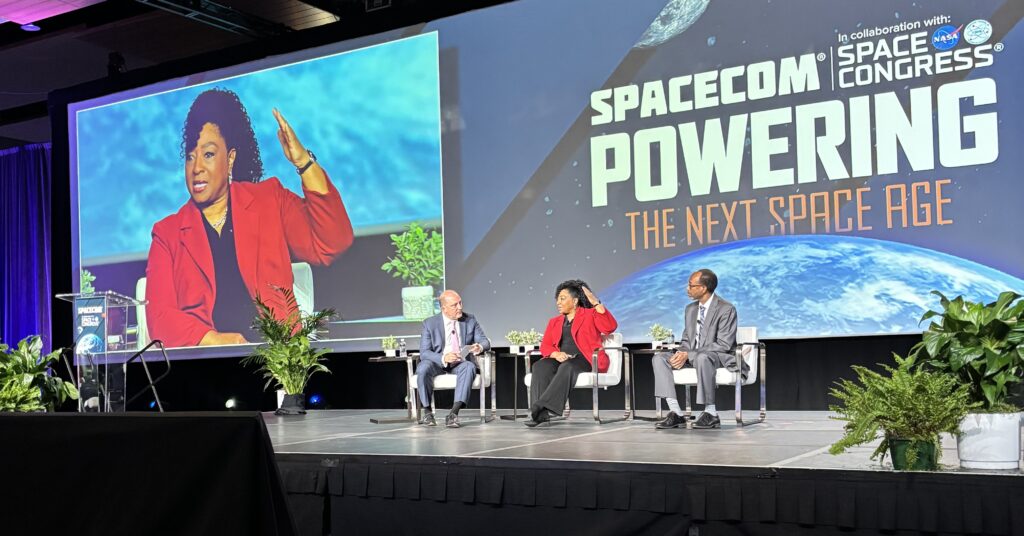
The space business got a major boost with the official launch of a new investment venture launched at the Spacecom Conference and Expo in Orlando.
Andromeda Ventures, with former NASA luminary Christyl Johnson at the helm, plans to take the early lead in investing in space, defense, energy, health and AI-enabled autonomy.
Johnson, formerly associate administrator and deputy associate administrator at the NASA Space Technology Mission Directorate, is part of a powerhouse team that includes Clayton Turner, former associate administrator for the NASA Space Technology Mission Directorate, Christian Elam, founding general partner of Bachmanity Capital and Dan Fata, former vice president, government affairs, at Lockheed Martin.
Andromeda plans to make investments from pre-seed through series A financing rounds as they leverage the collective wisdom of their in-house experts to identify and fund the most promising technologies for dual use for space and Earth.
The key is the Andromeda investments are expected to align with government technology roadmaps that have well-defined capability gaps.
Johnson has a long history with NASA in a wide range of roles that align with new role of Andromeda.
Selecting leading-edge technologies is hardly new to Johnson.
For example, speaking at the AI Summit in London in 2024, Johnson, then deputy director for technology and research investments at the NASA Goddard Space Flight Center, detailed the future role of robotics, AI, and 3D printing for sustaining human life on Mars.
In a video interview I did with Johnson at the AI Summit, she discussed the need for harnessing technology to have sustainable human presence on Mars, issues relating to drones and flying taxis.
AI for space
She noted the need for space necessities such as sustainable food and agriculture and using machine learning for analyzing the massive amounts of data already collected to predict space events such as solar flares impacts on humans on Mars.
In the opening keynote fireside chat at Spacecom this week, Johnson highlighted the link from her past to present.
“Over the 35 years that I’ve been building technologies that are going to be necessary as missions, one of the things that is most meaningful for me was to see technologies that could be really revolutionary, get to a place where you have that gap between being able to demonstrate it.
“So many times it lacked the capital that it needed to be able to bridge that gap, that bridge between the development of those technologies, the commercial capability and making sure you have the capital.”
One of the obvious issues for things going into space is reliability. Many of the exhibitors at the Spacecom Expo emphasized that their products were required to meet rigorous standards. Johnson also focused on the issues of reliability and capability and taking a systems approach.
“We’re talking about capabilities,” she said. “We’re not just talking about getting through a demonstration of technology so that you can see the mission, but in order for you to have a really sustainable capability, you’ve got to get through all of the integration. You’ve got to get through all of the elements that are required for long-term capability, including infrastructure.
A systems approach
“It has to be a systems approach. You can’t look at one person in isolation, which is why you have to bring together all of the communities. And anyone here who knows me knows that I’ve spent a lot of time being a bridge, being a person who brings specific partners to the table, who brings non-traditional deliveries to the table, especially those communities today that don’t see themselves as space companies or space organizations, because all the things that they’re developing are going to be absolutely critical for a reliable and sustainable infrastructure, not just here on the planet, but in space.
“If you leverage the resources of those traditional companies, non-traditional space companies, along with the space ecosystem, it can move a lot faster than relying on the government to come with solutions.”
Part of the reasoning for a new investment arm is the realization of the complexity and volume of possible technologies, whether from startups or established brands, which cannot be managed by governments alone.
“There’s been a significant environmental shift,” Johnson said. “People truly understand now that the government cannot be responsible or expected to fund exploration, innovation; all of those things on their own.”
The most logical connections among Andromeda, government entities and technology innovators are the depth of connections of the Andromeda team, having been managing and leveraging technology ecosystems and partnerships for space and elsewhere for many years.
Best approaches
While at NASA, Johnson and Turner led the charge in analyzing the best technologies for any number of missions.
“We have been accustomed to setting the priorities within NASA, being part of the roadmap developments within NASA and then both of us have steep, steep, experience in execution,” Johnson said. “We understand what it takes actually to build a vision from start to finish, flying, going through all of the environmental testing and everything else.”
Johnson said she could be more effective as a bridge in the ecosystem outside of government.
While in Orlando, the Andromeda team already spent more than a day reviewing numerous presentations from startup companies, many of which are located in the Orlando area.
At NASA, Johnson and her team focused on the need for technologies that have to be developed for the future in space.
With Andromeda Ventures, she now leads the team geared to fund those technologies.