
By Chuck Martin
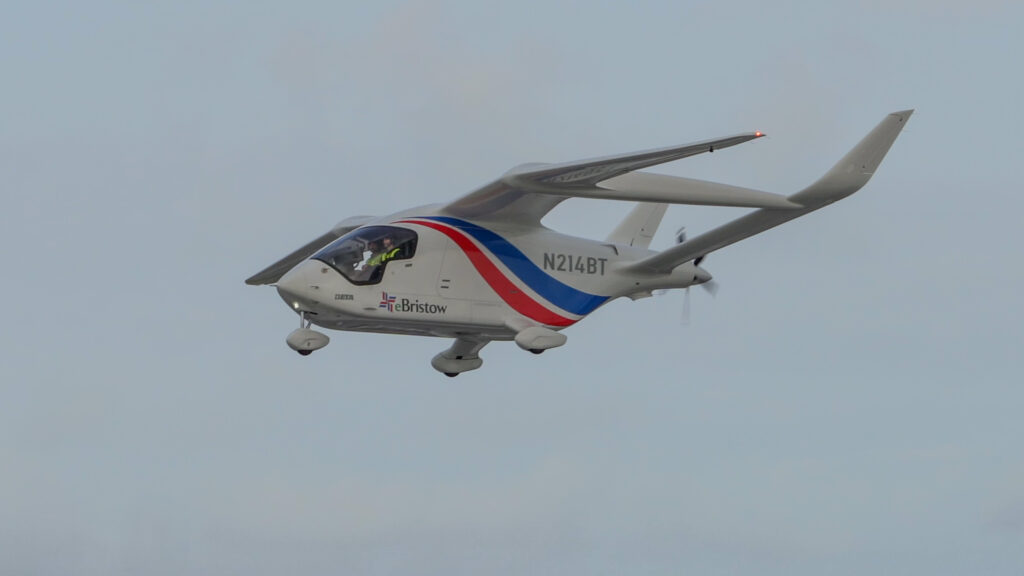
Alaska cargo carrier Ryan Air has placed an order for an undisclosed number of electric flying vehicles from air taxi company Beta Technologies.
The deposit-backed order also includes 10 charging cubes to be used across the Ryan Air network in conjunction with the Beta Alia conventional takeoff and landing vehicle.
Ryan Air is one of the main operators in Alaska’s aviation sector, where 85% of communities are not accessible by road. The carrier serves more than 70 area communities.
Many residents there depend on air, water or snowmobile transportation to access supplies.
“When we set out to develop our electric aircraft and chargers, it was with a mission to create aviation technologies that could increase access, fill critical needs and solve big problems,” Patrick Buckles, Beta director of commercial aircraft sales said in the announcement.
“Ryan Air has been committed to improving the quality of life for Western communities for decades, finding ways to reach the hard-to-reach populations with an aerial lifeline.”
The Beta electric aerial vehicle can carry five passengers or 1,200 pounds of cargo.
Beta recently announced a new strategic partnership with GE making an equity investment of $300 million in Beta.
The companies plan to develop a hybrid electric turbogenerator for applications including long-range vertical takeoff and landing vehicles as well as future Beta flying vehicles.
The hybrid technology would be developed by leveraging the GE Aerospace CT7 and T700 engines.
Beta also recently announced it was selling five of its Alia electric vertical takeoff and landing vehicles to FlyNyon, which operates a charter and photo tourism operation across New York City.
Delivery is expected to take place later this year, according to the company.
FlyNyon conducts helicopter flights over New York City starting from Kearny, New Jersey. The company focuses on trips specializing in aerial photography.
Beta has firm orders for its EAVs from UPS, Air New Zealand, United Therapeutics, Bristow, Blade, Helijet, Metro Aviation, New Zealand Air Ambulance, Republic Airways and the U.S. Department of Defense, according to the company.
Earlier this year, Beta installed flying taxi charging stations at Florence Regional Airport, the first in the state of South Carolina.
The chargers, made by Beta from Burlington, Vermont, can power various types of electric aerial vehicles as well as electric ground vehicles.
The airport now has a fast-charger on the airside for EAVs and a two-port charger in the parking lot for public use.
Beta has an agreement with 47G Utah Aerospace and Defense to launch advanced air mobility operations across that state.
The two organizations plan to identify the best routes for EAV operations.
As part of the AAM approach, Beta would build out its multimodal electric charging infrastructure and determine locations for EAV demonstrations and pilot training.
The EAVs would start with electric conventional takeoff and landing vehicles followed by eVTOL vehicles.
Last year Beta completed the first flight of its production line EAV, the Beta Alia eCTOL manufactured at the Beta production facility in Burlington.
A multipurpose special airworthiness certificate for experimental research and development was granted by the Federal Aviation Administration following its inspection of the EAV.
The test flight was conducted by Clark, who also is a test pilot.
The flight included takeoff, climbing to 7,000 feet, “handling qualities evaluation, stability and control test points and initial airspeed expansion prior to flying several approaches and a normal landing,” according to the company.
Many EAVs are eVTOLs, which do not require traditional runways, since they take off and land straight up and down.
Before the GE investment, Beta raised more than $1 billion, including funding from QIA, one of Beta’s largest investors, Fidelity Management and Research Company, TPG Rise Climate and United Therapeutics.
Beta has received an order for 20 EAVs from Metro Aviation, an air medical operator that operates in 27 states, which plans to use the flying vehicles for air medical operations.
Metro plans to integrate the Alia into its fleet to increase access to rural and urban areas and to provide inter-hospital and scene transport.
The lower operational costs and increased utility are expected to allow eVTOL vehicles to offer better transport opportunities than current medical transportation methods.
The passenger version of the EAV is expected to launch after the Beta cargo and medical versions, targeted for this year.
Beta is also in the electric charging business, having installed aircraft electric charging stations at Eglin Air Force Base, Tallahassee International Airport, Gainesville Regional Airport, Bob Sikes Airport and now Florence Regional Airport.
Beta has added more than 35 charging stations along the east, west and gulf coasts with each Florida installation including a level three fast charger located inside the fence, known as airside, for use by EAVs and electric airport ground vehicles, and a level two charger outside the fence, known as landside, for ground EVs.
Beta chargers have been purchased by Archer Aviation, Atlantic Aviation, Signature Aviation, AvFlight, and the Department of Defense.
Beta is also installing charging stations outside Florida in partnership with airports and other partners across the U.S.
Beta won a $20 million federal contract with the U.S. Department of Health and Human Services Administration for Strategic Preparedness and Response to install EAV chargers in rural areas along the east and gulf coasts.
The contract would allow Beta to build charging stations to enable an emergency preparedness platform for the federal department to establish a cost-effective network to deliver equipment, pharmaceuticals and patients, even in remote areas.
Beta also received a $2.6 million grant from the state of Michigan to help scale AAM, which came via Michigan’s AAM Activation Fund to create a centralized pipeline of projects to drive AAM growth in the state.
In late 2023, Beta was granted $20 million from the Clinton County from Empire State Development’s Regional Economic and Community Assistance Program in New York to expand its operations at Plattsburgh International Airport.
Beta was approved for a $169 million loan to finance its net-zero final assembly production facility from the Export-Import Bank of the United States.
The 188,500 square foot manufacturing facility opened in 2023 at the Patrick Leahy Burlington International Airport, where Beta is building its eVTOL and CTOL vehicles.
The production facility, on a 40-acre site at the airport, could ultimately produce 300 EAVs a year, according to the company.
Beta has partnered with AFWERX, the innovation arm of the U.S. Air Force that leverages the Air Force Research Laboratory for this program.
Vertiport facilities to manage the takeoff, landing, charging and maintenance of such vehicles are being established by companies such as Florida-based Aeroauto Global, which is also developing retail showrooms for flying vehicle sales.